
The recent upgrade of “The Game” to a larger Twin Ports signal, while also staying on the original frequency, is the latest addition to what has become a long list of radio station simulcasts in the Twin Ports.
WDUL/970 (Superior-Duluth) could eventually adopt a new format now that “The Game” is on WDSM/710 and W251CD/98.1 (Superior-Duluth). But for now, they’re carrying the same programming most of the time unless play-by-play sports is airing on one of the stations.
It joins two other full-time simulcasts that have popped up in the last few years: “Life 97.3” on two signals and “The Current” on three.
The programming of “Life 97.3” (KDNW Duluth) has been simulcast on WJRF/89.5 (Duluth) since Northwestern Media received WJRF as a donation more than two years ago. The only exception is that WJRF has been used to carry KDNW’s regular Contemporary Christian format when the main station goes into All-Christmas mode.
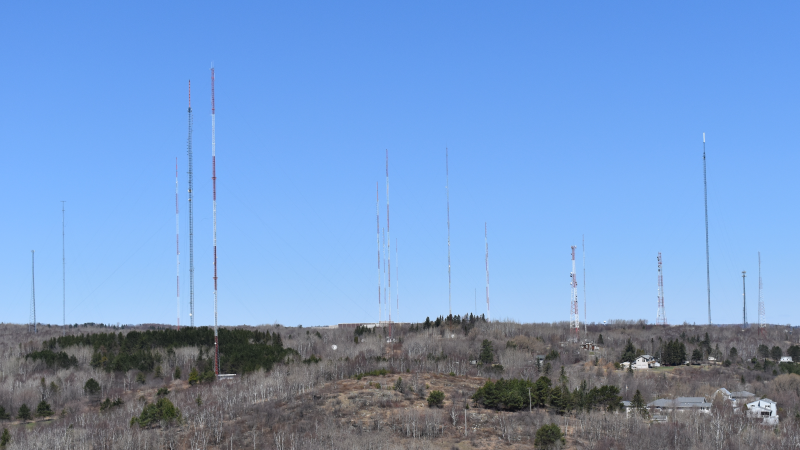
Both KDNW and WJRF transmit from the Duluth antenna farm. WJRF has a construction permit to upgrade to a facility more closely matching KDNW’s coverage area, leaving open the possibility to serve new audiences in the future.
Meanwhile, Minnesota Public Radio’s “The Current” is heard on three analog signals as well as the HD2 channel of WSCN/100.5 (Cloquet-Duluth). The original frequency, W215CG/90.9 (Duluth), suffered heavy interference when it first signed on, leading MPR to buy K231BI/94.1 (Duluth) and KZIO/104.3 (Two Harbors) in 2017.
W215CG’s signal drastically improved when second-adjacent KUWS/91.3 (Superior) ended HD broadcasting in 2020 but W215CG continues to carry the same programming as K231BI. Both transmit from the Duluth antenna farm, while the out-of-town 104.3 signal has always had reception issues in Duluth due to topography and interference.
With state networks from both Minnesota and Wisconsin transmitting from the Duluth hillside, there are also several instances of national programming airing simultaneously on two stations in various dayparts.
The syndicated “Classical 24” service is carried in the evening and overnight hours on both MPR’s WSCD/92.9 (Duluth) and WPR’s WSSU/88.5 (Superior). For several hours overnight, MPR’s WSCN and WPR’s KUWS both carry the BBC World Service.
There’s also a notable amount of duplication of national news programming between WPR’s two services and WSCN. Both WSCN and WSSU carry “Morning Edition” and “All Things Considered,” though MPR heavily restructures the programs for Minnesota audiences while WPR sticks to the national feed with state news inserts.
Adding further to the duplication, WPR’s WHSA/89.9 (Brule) carries the same network as WSSU and is easily heard on the Duluth hillside and lakeside. WSSU reaches Superior itself better due to topography, despite the fact that its transmitter is in Duluth.
Why all of this simulcasting? In the case of the full-time simulcasts, it may be that the owners simply don’t have any other use for the duplicate stations at the present time. (Duluth is the only place where Northwestern has three full-power FM’s. MPR doesn’t offer more than three analog services anywhere in the state.)
In the case of the partial public radio simulcasts, it’s a case of border duplication not being a factor in statewide network programming decisions. Automation could easily allow alternate programming to be carried locally, but networks may feel that the overall lineup is a better product for their target audience even with duplication.
For the listeners, all of the duplication means fewer choices. For the stations, it means lost potential to serve new audiences.